
Hak5
AI Audio Summaries
14 videos summarized
1 follower on BriefTube
Last summary: Oct 5, 2026
AI Audio Summaries
14 videos summarized
1 follower on BriefTube
Last summary: Oct 5, 2026
Read AI summary
YouTube
Google Chrome has been installing significant AI models, specifically 4GB worth of weights for Gemini Nano, onto user devices without explicit permission. This model, named `weights.bin`, powers features like scam detection and "help me write." Deleting the file results in Chrome automatically redownloading it when AI features are active, which are enabled by default. Users can only prevent this cycle by disabling Chrome's AI features via flags or enterprise policies, or by uninstalling Chrome. This behavior has been confirmed on Windows and Mac OS, with similar download mechanisms. Separately, two Linux zero-day vulnerabilities, dubbed "Dirty Frag" (CVE-202643284 and CVE-202643500), have been discovered. These kernel flaws allow local privilege escalation by chaining together an XFRMP page cache write vulnerability and an RX RPC page cache write vulnerability, enabling unauthorized kernel cache writes without system crashes or special permissions. Microsoft has confirmed their exploitation in the wild. The researcher initially found these in April but a public disclosure by a third party has prevented immediate patching or CVE assignment.
Read AI summary
YouTube
A critical vulnerability, "copyfail" (CVE-2026-31431), affects Linux kernels built between 2017 and recently, scoring 7.8 CVSS. Discovered by Xent code and initially reported by Tayyang Lee, it allows an unprivileged local user to achieve root access on Linux distributions. The flaw, a logic error in the kernel's AEAD crypto implementation, allows a write beyond intended bounds by chaining with AF_ALG sockets and splice, overwriting four bytes in the page cache of any readable file, including set UID binaries. This can also lead to container escapes. Patches were committed on April Fool's 2026, with multi-tenant Linux hosts prioritized for patching. Separately, GitHub experienced a major remote code execution (RCE) vulnerability (CVE-2026-2854, CVSS 8.8) in its Git infrastructure, discovered by Whiz Research using AI. This marks one of the first critical flaws found in closed-source binaries via AI. The attack exploited unsanitized characters injected via option fields in the `git push` function, affecting downstream services. GitHub deployed a fix on March 4th, 2026, and found no evidence of exploitation.
Read AI summary
YouTube
This cybersecurity news roundup covers several critical incidents. Bitwarden experienced a software supply chain attack on April 22nd, 2026, affecting its NPM-distributed version for 90 minutes. This attack, linked to the "checkmarks" vulnerability, compromised CLI identities to steal credentials from developer workstations, targeting GitHub, NPM tokens, SSH material, AWS, GCP, Azure, and GitHub action secrets. Developers are increasingly targeted, making cybersecurity education crucial. Apple released a patch for CVE 2026-28-950, addressing a vulnerability allowing the unexpected retention of deleted notifications, which had been exploited to retrieve Signal messages. Signal publicly thanked Apple for the swift fix.
Read AI summary
YouTube
This week's cybersecurity news roundup, hosted by Ally Diamond on ThreatWire, covers several significant events and trends. A major data breach at Verscell, stemming from a security incident at Context.ai, has raised concerns about OAUTH token management and shadow IT. Context.ai, a company that builds AI agents for specific industries like semiconductors and legal, experienced unauthorized AWS access. While Context.ai used CrowdStrike for remediation, Verscell, a user of Context.ai, was unknowingly affected. The compromise occurred when an attacker used a leaked OAUTH token, originally intended for a Verscell employee's Google Workspace account via Context.ai, to gain access to Verscell's Google Workspace. This token had "allow all" permissions granted, allowing the attacker to then access Verscell's environment variables. Verscell's CEO stated that only non-sensitive environment variables were compromised and that a small number of customers were affected, attributing the attack's acceleration to AI. However, the host argues this was primarily a failure of OAUTH management and shadow IT on Verscell's part, not an AI-driven attack, highlighting the need for better employee education on OAUTH tokens and permissions.
Read AI summary
YouTube
We are seeing a rapid shift towards an age-restricted internet, as highlighted in this week's cybersecurity news. The "Age of Us" remains a prominent topic in technology. California passed a law in October 2025 requiring all operating systems within the state to collect user age information. Although set to take effect in early 2027, internal concerns have already surfaced due to ambiguities, particularly regarding multi-use computers. This law will impact operating systems and groups such as Linux, Mac, Windows, and Steam OS. It's uncertain if related, but Apple has already initiated age verification in the UK. iOS 26.4 introduced age and identity checks for UK-based iOS users. According to an Apple support page, users in certain countries may need to confirm their age before downloading apps, changing settings, or performing other actions with their Apple account. These checks involve using a driver's license, ID, or credit card, but not a UK passport. However, a US passport can be used to create a digital ID in an Apple wallet for age confirmation. This has created difficulties for many in the UK who lack licenses or credit cards, making age verification impossible for them.
Read AI summary
YouTube
This week's cybersecurity news roundup covers a range of significant incidents and trends, including ongoing fallout from Team PCP's attacks, critical vulnerabilities in web browsers, the rise of AI in vulnerability discovery, and important updates to DNS security guidance. The threat actor group Team PCP continues to be a major concern, with Cisco now confirmed to be a victim of their supply chain attacks. Team PCP previously infiltrated platforms like GitHub Actions, Docker Hub, NPM, OpenVSX, and PyPI using compromised credentials. In the Cisco incident, attackers gained access to credentials and data from build and development environments, including AWS keys. These keys were then used for unauthorized activities across several Cisco AWS accounts.
Read AI summary
YouTube![🔴 [PAYLOAD REVIEW] WiFi Pineapple Pager 📟🍍](https://img.youtube.com/vi/_7A6R_ydNUU/hqdefault.jpg)
The speaker begins by expressing his pleasure at being present with the audience and Darren. He notes that he's had a busy few weeks, including a recent surgery, and that things are going well in his personal life. He mentions trying something new and that his primary reason for being there is because he misses the community. He then transitions to discussing a new feature he's working on for the 1.0.8 announcement. He points out a new element on the screen, which is metadata for theme developers, including payload title, description, version, and author. He expresses excitement about this feature, as it allows for celebrating the community.
Read AI summary
YouTube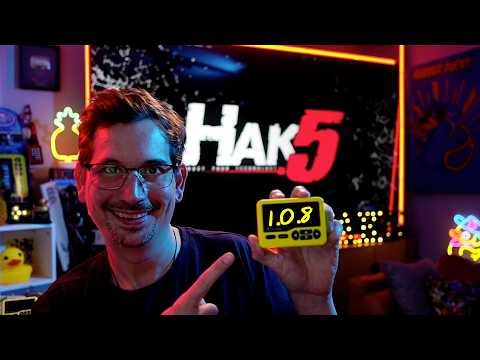
HackFive has released new firmware version 1.0.8 for the Wi-Fi Pineapple Pager, available for download or over-the-air update. This update brings significant improvements in payloads, user experience, and the underlying system. A standout new feature is the dynamic list picker for payloads, which allows for the creation of interactive, menu-driven interfaces. This feature is demonstrated with a simple ping utility that presents a menu with options like "Ping IP," "Configure IP," "About," and "Exit." The menu allows users to select actions, and the system provides feedback on success or failure, returning to the main menu afterward. The "About" section showcases nested lists, demonstrating the capability for complex, multi-layered menus.
Read AI summary
YouTube
This week's cybersecurity roundup covers a new cyber threat from Team PCP, an FCC ban on foreign-made routers, a compliance startup accused of fraud, and Cloudflare injecting tracking scripts. Team PCP, claiming to be based in Israel but operating out of Africa, has launched a series of fast-moving cyberattacks. On March 19th, 2026, they injected credential-stealing malware into Trivy, a code scanner by Aqua Security. The initial infiltration used compromised credentials obtained in late February from a misconfigured GitHub Actions environment. Aqua Security had disclosed the incident, but the credential rotation was incomplete. Team PCP exploited this, modifying the Trivy action repo to point to malicious commits, triggering an automated malicious publishing. The Trivy team quickly regained control and removed the malicious versions. Just days later, Team PCP executed a near-identical attack, targeting a static code analysis tool for infrastructure as code. This occurred on March 23rd, using compromised identities to update GitHub action tags, exfiltrate sensitive information, create privileged pods, and install malware. Their next target was Light LLM, an LLM access management and spend tracking tool with over 95 million monthly downloads. Reported by Ender Labs on March 24th, 2026, this software supply chain attack compromised the Light LLM library to include backdoor executions upon import. It harvested SSH tokens, keys, wallets, and ENV files, moved across Kubernetes clusters, and installed persistent backdoors. Malicious versions 1.82.7 and 1.82.8 on the PyPI package indexer were quickly taken down. Other attacks by the group affected GitHub Actions, DockerHub, npm, openvsx, and PyPI. The group's operational cadence was aggressive, with a new target every one to three days: Trivy on March 19th, Canister Worm March 20th-22nd, Tex Marks March 23rd, Light LLM March 24th, and Telnix March 27th. SANS instructor Kenneth Hartman noted the group emerged in 2024, initially exploiting misconfigurations, then pivoted to supply chain attacks in 2025, setting up infrastructure for these combined attacks.
Read AI summary
YouTube
This week's cybersecurity news roundup covers significant developments in mobile security and AI integration. Apple is facing scrutiny for security vulnerabilities in its iOS ecosystem, with two new exploit kits, Karuna and Dark Sword, being discovered. Karuna, identified in early March 2026, targeted iPhones running iOS versions 13.0 through 17.2.1, utilizing five exploit chains and 23 exploits. It operates by luring users to malicious websites where a hidden iframe delivers the exploit kit. Karuna's strength lies in its comprehensive collection of iOS exploits, including advanced, non-public techniques and bypasses for mitigation. The kit begins by fingerprinting the device, then uses a WebKit RCE exploit followed by a pointer authentication code bypass. Once successful, it injects a loader into a root-level demon to steal financial information and user credentials. Apple released a patch for Karuna, but researchers at Lookout, in collaboration with Google and I Verify, discovered Dark Sword shortly after.
Read AI summary
YouTube
This week’s cyber security news roundup, hosted by Alli Diamond on ThreatWire, highlights significant advancements in quantum-resistant encryption, recent malware incidents, and new AI-driven security tools. A major focus of the report is Google Chrome’s proactive shift toward quantum computing security. The Chrome team is developing a new generation of HTTP certificates based on Merkel tree structures. This initiative aims to solve the performance and bandwidth issues caused by the larger data sizes typical of quantum-resistant cryptography in TLS connections. Google has outlined a three-phase plan concluding in early 2028. Currently, in phase one, they are collaborating with Cloudflare to evaluate performance. Subsequent phases will involve working with certificate transparency log operators and eventually onboarding certificate authorities into a new quantum-resistant root store.
Read AI summary
YouTube![🔴 [PAYLOAD REVIEW] WiFi Pineapple Pager 📟🍍](https://img.youtube.com/vi/9dmkiMOt5Og/hqdefault.jpg)
This summary covers the key insights, technical updates, and payload demonstrations from the Hack Five Payload Power Hour, focusing on the development of the Wi-Fi Pineapple Pager. ### Firmware Development and Infrastructure Updates
Read AI summary
YouTube
In the latest cyber security news roundup for the week of March 2, 2026, host Allie Diamond highlights significant developments in mobile operating systems and a high-stakes conflict between AI giant Anthropic and the U.S. government. The episode begins with the announcement of a partnership between Motorola and GrapheneOS. Known for its rigorous security and privacy standards, GrapheneOS was previously exclusive to Pixel phones. This collaboration aims to bring the secure, Android-compatible operating system to Motorola hardware, provided the devices meet strict hardware-based security requirements. This move reflects a growing trend in mobile security, following Apple’s recent success in achieving NATO approval for iPhones and iPads to handle classified information without third-party modifications.
Read AI summary
YouTubeBriefTube monitors your YouTube channels, generates AI-powered audio summaries, and delivers them wherever you listen. Telegram, Discord, Slack, or your podcast app. Fully automated.
Start free trial![🔴 [LIVE] Hak5 Hits 1 MILLION SUBSCRIBERS](https://img.youtube.com/vi/BaoTgxg2NQ4/hqdefault.jpg)